Moving An NFL Team Total From 18.5 To 19.5 Buys You 1.7 Percent. Moving It To 20.5 Buys You 8.1 More
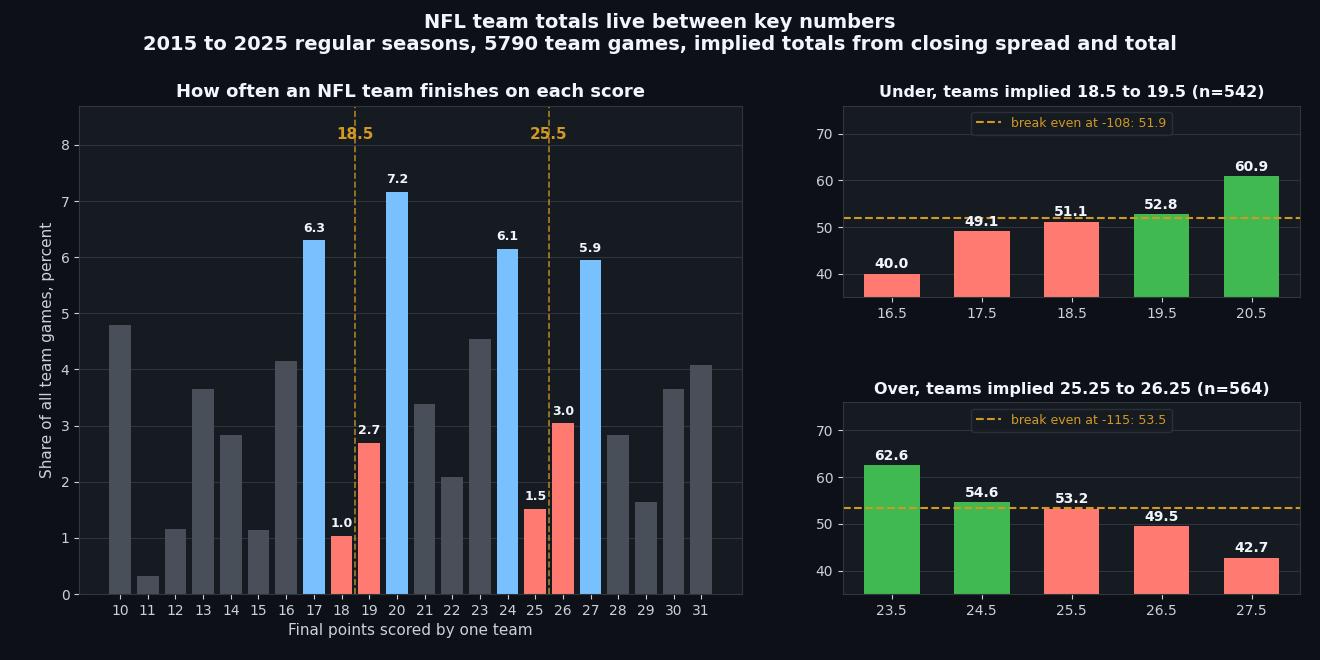
Two of the five tickets on the Sunday NFL card for September 13 are team totals, and they sit on opposite sides of the same problem. Arizona Cardinals team total under 18.5 at -108 and Dallas Cowboys team total over 25.5 at -115. Both numbers end in a hook. Anyone who has bet an NFL spread knows a hook around 3 or 7 is expensive. What almost nobody checks is what a hook is worth on a team total, where the number is half the size and the scoring lands on different spots.
So we counted. Not a model, not a projection. Every final score, every team, eleven seasons.
What we measured
Every regular season NFL game from September 10 2015 through January 4 2026, 2,895 games and 5,790 team games. We start in 2015, the first season with the longer extra point, so every game in the sample was played under the same kicking rules. For each team we took the closing spread and the closing total and turned them into the team's implied points: half the total, plus half the spread for a favorite or less half the spread for an underdog. Then we compared that to what the team actually scored.
Most of the scoreboard lives on four numbers
| Final score | Share of all 5,790 team games | What it usually is |
|---|---|---|
| 17 | 6.3% | Two touchdowns and a field goal |
| 18 | 1.04% | The dead zone |
| 19 | 2.69% | The dead zone |
| 20 | 7.17% | The single most common final score in the sample |
| 24 | 6.15% | Three touchdowns and a field goal |
| 25 | 1.52% | The dead zone |
| 26 | 3.04% | The dead zone |
| 27 | 5.94% | Three touchdowns and two field goals |
A team finishes on 20 about seven times as often as it finishes on 18. It finishes on 24 about four times as often as on 25. That is the whole study in one sentence: the line on a team total can move a full point and change almost nothing, or move a half point and change a lot, and which one depends entirely on where it sits.
The Cardinals ticket, under 18.5 at -108
On the DraftKings board read at 3:36 AM Pacific on Sunday, Arizona is +9.5 at the Chargers with a total of 47.5. That implies 19.0 points for the Cardinals, and the posted team total is 18.5. So we pulled every team the closing market implied between 18.5 and 19.5 points. There are 542 of them, and they averaged 18.7 points.
| Team total line | Under cashed | Fair price at that rate |
|---|---|---|
| Under 16.5 | 40.0% | +150 |
| Under 17.5 | 49.1% | +104 |
| Under 18.5 | 51.1% | -105 |
| Under 19.5 | 52.8% | -112 |
| Under 20.5 | 60.9% | -156 |
Read it from the ticket outward. In this group 49 teams finished on exactly 17 and 44 finished on exactly 20. Only 11 finished on 18 and 9 on 19. So moving from 18.5 to 19.5 buys 1.7 percent. Moving from 19.5 to 20.5 buys 8.1 more. If a book offers under 19.5 at anything worse than about -112, the extra half point costs more than it is worth. If a book offers under 20.5 at -140, that is a number this sample says is worth up to -156.
And the honest part. At -108 the under needs 51.9 percent. The base rate for teams implied around 19 is 51.1 percent, a shade short. The number alone does not pay for this ticket. What the table says is that the price is close to fair and that the line sits in a place where shopping the juice matters more than shopping the hook. Whatever edge is in the play has to come from the matchup, not from the number.
The Cowboys ticket, over 25.5 at -115
Dallas is -3 at the Giants with a total of 48.5, which implies 25.75 points. The posted team total is 25.5, a quarter point under the implied number, which already leans toward the over. We pulled every team implied between 25.25 and 26.25. There are 564 of them, and they averaged 26.4 points.
| Team total line | Over cashed | Fair price at that rate |
|---|---|---|
| Over 23.5 | 62.6% | -167 |
| Over 24.5 | 54.6% | -120 |
| Over 25.5 | 53.2% | -114 |
| Over 26.5 | 49.5% | +102 |
| Over 27.5 | 42.7% | +134 |
Same shape, other side. In this group 45 teams finished on 24 and 38 on 27, and only 8 finished on 25. Buying the over down from 25.5 to 24.5 gains 1.4 percent, and the fair cost of that half point is about six cents, -114 to -120. Buying it again to 23.5 gains 8.0 more, which is why 23.5 is priced like a different bet entirely.
At -115 the over needs 53.5 percent and this group cashed 53.2 percent. That is about as close to even as a base rate gets. It also means the ticket is not paying a tax for the hook, because the whole number it gives up, 25, is one of the rarest finishes on the board. The line most worth fearing on this bet is not 25.5, it is 26.5, where a 26 stops cashing and every 27 has to carry the ticket alone.
How to use this on any team total
Before paying extra juice for a half point, find the whole number the half point protects. If it is 17, 20, 24 or 27, pay. If it is 18, 19, 25 or 26, the juice is almost always the better thing to save. A team total that sits right on the key number side, like under 20.5 or over 23.5, is worth a noticeably worse price than one a half point away.
The two team totals on Sunday's card both sit in the dead zone, which is exactly why the prices matter more than the lines on them.
What this is not
This is a base rate for teams the market priced a certain way, not a rating of the Cardinals or the Cowboys. The implied points come from the closing spread and total, not from a posted team total, because closing team totals are not in the historical feed. On Sunday's two tickets the posted team total sat a half point and a quarter point under the implied number, which is why we measured a full point band around each one rather than a single exact line.
It is also 542 and 564 teams in the two bands. That is enough to see the dead zone clearly, since 44 teams on 20 against 11 on 18 is not noise, and it is not enough to say a 51.1 percent base rate is really worse than a 51.9 percent break even. Those two numbers are well within the sample's error of each other.
Method: nflverse games data, regular season games from September 10 2015 through January 4 2026, completed games with a closing spread and closing total, 2,895 games and 5,790 team games. Implied team points are half the closing total plus half the spread for the favorite and less half the spread for the underdog. Final scores include overtime. Fair prices convert the hit rate to American odds with no margin. Sunday's lines are the DraftKings board as carried on the TrustMyRecord sportsbook feed, read at 3:36 AM Pacific on September 13 2026: Cardinals +9.5 and 47.5 at the Chargers, kickoff 1:25 PM Pacific, and Cowboys -3 and 48.5 at the Giants, kickoff 5:20 PM Pacific.